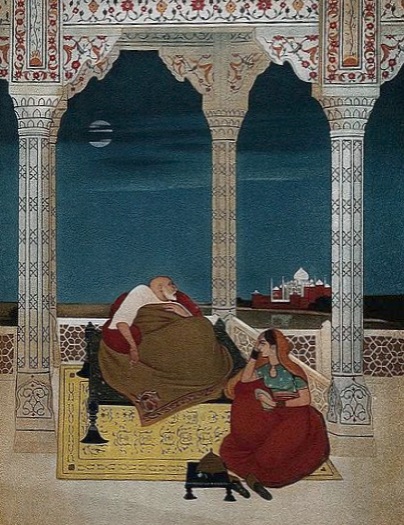
In all of Delhi’s history, at no period was that thin dress of civilisation more beautiful – or more woven – than during the first half of the seventeenth century, during the Golden Age of Shah Jehan. After the death of his beloved queen Mumtaz Mahal, Shah Jehan decided to move his court from Agra to Delhi. He had just lost his wife; his children were now grown up. The building of a new city (Shahjehanabad within Delhi) was the middle-aged Emperor’s bid for immortality.
Shah Jehan had himself come to power twelve years earlier after a bloody civil war. He had been the able but ruthless third son; to seize the throne he had had to rebel against his father and murder his two elder brothers, their two children, and two male cousins. Yet, while Shah Jehan was capable of bouts of cold-blooded brutality, he was still the most aesthetically sensitive of all the Mughals. As a boy of fifteen he had impressed his father, the Emperor Jehangir, with the taste he demonstrated in redesigning the Imperial apartments in Kabul. As the young Emperor he had rebuilt the Red Fort in Agra in a new architectural style that he had himself helped to develop. Then, on his wife’s death, he had built the Taj Mahal, arguably the most perfect building in all Islam.
Before her death Mumtaz Mahal had borne Shah Jehan fourteen children; of these, four sons and three daughtera survived to adulthood. The eldest was Dara Shukoh – the Glory of Darius. Contemporary miniatures show that Dara bore a striking resemblance to his father; he had the same deep-set almond eyes, the same straight, narrow nose, and long, full beard, although in some pictures he appears to have been slightly darker and more petite than Shah Jehan. Like the Emperor he was luxurious in his tastes and refined in his sensibilities. He preferred life at court to the hardships of campaigning; he liked to deck himself in strings of precious stones and belts studded with priceless gems; he wore clothes of the finest silk and from each ear lobe he hung a single pearl of remarkable size.
Nevertheless, Dara was no indolent voluptuary: he had an enquiring mind and enjoyed the company of sages, Sufis and Sannyasin (wandering ascetics). He had the Hindu Upanishads, the Bhagavad Gita and the Yoga-Vashishta translated into Persian and himself composed religious and mystical treatises. The most remarkable was the Majmua-ul-Baharain (‘The Mingling of the Two Oceans’), a comparative study of Hinduism and Islam which emphasised the compatibility of the two faiths and the common source of their divine revelations. In an age when even the most liberal of Mughal Emperors used to demolish Hindu temples, this was both a brave and novel work; but some considered Dara’s views not just unusual but actually heretical. In private, many of the more orthodox Muslim nobles furrowed their brows and wondered how the crown prince could possibly declare, as one noble put it, ‘infidelity and Islam to be twin brothers’.
Prince Aurangzeb, Shah Jehan’s third son, was a very different character from his elder brother. As tough and warlike as Dara was civilised and courtly, he cloaked his ambition in a robe of holy simplicity, affecting the ways of a Muslim dervish. A master of deceit, he learned how to sow distrust and dissent within the ranks of his enemies. He controlled an efficient network of spies: nothing could be said in Delhi without Aurangzeb coming to hear of it. Moreover, he knew the art of poisoning with subtle toxins.
One person whom Aurangzeb never deceived was his father. From an early age, Shah Jehan made it clear that he did not care for his third son, and instead increasingly lavished attention on the more amiable Dara Shukoh. Dara he kept at court, showered with favours and titles, while Aurangzeb was sent to the empire’s southernmost border, the unruly Deccan.
All the cards seemed to be stacked against Aurangzeb, but he had one key advantage: the support of his sister Roshanara. Just as Aurangzeb was angered by Shah Jehan’s obvious preference for Dara, so Roshanara was alienated by the affection lavished on her more attractive sister Jahanara Begum. After the death of Mumtaz Mahal, Jahanara had been given charge of the Imperial harem. Bazaar rumour had it that her closeness to Shah Jehan went beyond merely normal filial affection.
As Jahanara’s influence increased, so did the jealousy and resentment of her younger sister. Like Aurangzeb, Roshanara grew bitter and vengeful. She became a tireless champion of Aurangzeb’s interests, making little secret of her hatred for Dara and Jahanara. Like Aurangzeb, she controlled a network of spies which she used to keep her brother well in touch with developments in the court. It was rumoured that she was also a poisoner and a witch. Yet she remains for the modern reader perhaps the most intriguing member of the entire family.
In June 1658, Aurangzeb besieged his father Shah Jehan in the Agra Fort, forcing him to surrender unconditionally, by cutting off the water supply. Jahanara came to Aurangzeb, proposing a partition of the empire. Dara Shukoh would be given the Punjab and adjoining territories, Shuja would get Bengal, Murad would get Gujarat, Aurangzeb’s son Sultan Muhammad would get the Deccan, and the rest of the empire would go to Aurangzeb. Aurangzeb refused Jahanara’s proposition on the grounds that Dara Shukoh was an infidel.
On Aurangzeb’s ascent to the throne, Jahanara joined her father in imprisonment at the Agra Fort, where she devoted herself to his care till his death in 1666.
***
The above excerpts were taken from William Dalrymple’s book City of Djinns: A Year in Delhi.
 Kalampedia