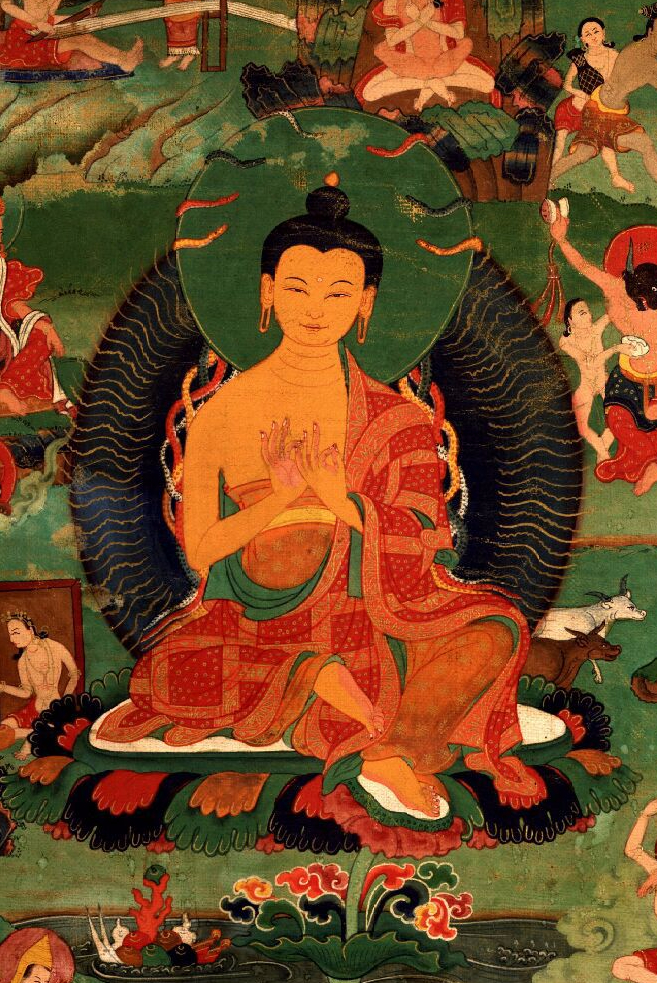
Nagarjuna was a renowned Buddhist sage who lived in the second and third century AD. His writings, particularly his commentaries on Buddhist philosophy, hold great significance even today. One of the popular collections is called Nagarjuna’s Letter to King Gautamiputra which has been published under the same title and translated in all major languages. Nagarjuna wrote this letter for his friend and patron Gautamiputra, the then King of Andhra in the South of India. The letter, now published as a book, contains the fundamentals of Buddha’s teachings, especially for a layperson.
In this post, we will discuss some of these teachings. The explanatory notes are based on Tibetan commentaries by Venerable Lozang Jamspal, Venerable Ngawang Samten Chophel and Peter Della Santina. Let’s start.
The race of one who worships father and mother is in company of that of Brahma and that of preceptors; through revering them one will win fame and later will attain the higher realms.
Explanation: One should respect his parents, because they are the people who are the kindest to oneself in the present life. Those who give respect to their parents are gentle, blissful and will obtain many good qualities in this life and in the next. The Buddha declared that one who assists his parents is said to be of the Brahma-race. Always revere teachers, parents and likewise all sentient beings, and do not fall under the sway of pride.
Forsake killing, theft, sexual misconduct, lying, alcohol, attachment to food at improper times, enjoyment of high seats and beds, and all kinds of songs, dances and garlands.
Explanation: It is generally very difficult for the laymen to practise these eight precepts at all times. However, it is important that they be practised occasionally, and especially on religious holidays, such as the day of commemorating the Buddha’s attainment of enlightenment etc.
Look upon these as enemies: miserliness, cunning, deceit, attachment to property, laziness, pride, sexual attachment hatred, and arrogance of caste, form learning, youth and great power.
Explanation: One should look up the following as enemies:
- To be avaricious and miserly
- To hide one’s own faults
- To show one’s qualities by false methods
- To desire one’s own body and health
- To be lazy
- To have pride
- To be lustful
- To be angry towards one’s enemies
- To have pride of race
- To have pride of form
- To have pride of learning
- To have pride of ‘prime of life’
- To have pride of power
Heedfulness is the source of the deathless and heedlessness is the source of death; hence to increase your virtue, devotedly remain heedful. One who has formerly been heedless, but later becomes heedful – like Nanda, Angulimala, Ajatshatru and Udayana – will also be resplendent like the moon free from clouds.
Explanation: Even if one has performed non-virtuous deeds in the past, that should not prevent one from being heedful and mindful at the present time. For example, Nanda who had much desire, Angulimala who had much hatred, Ajatshatru who killed his own father, and Udayana who killed his own mother, were, at first, all sinful people who were totally under the sway of their defilements. However, they later entered the path of religion and became worthy men. Having committed so many sins in the past, people feel that they are now not worthy or capable of practising Dharma. However, this is not true.
Since there is no penance like patience, you must give anger no opportunity to arise. The Buddha said that by giving up anger, one will attain the irreversible stage.
Explanation: Burning one’s body, diving into water, eating poor food such as roots and the like, and wearing poor clothes are not true acts of penance. It is said that such acts cannot even guarantee a higher rebirth in Samsara. Rather, the greatest act of penance is patience. Therefore, it is important to practise patience, especially when undesirable events happen to oneself. In this way, one will gain happiness.
Recognise the mind to be like a drawing made on water, earth or stone; the first among these is excellent for those possessing the defilements, and the last for those desiring religion.
Explanation: The mind is of such a nature that various thoughts, remembrances etc can be categorised under three aspects which imply duration. That is, a mental event may be of very brief duration, of a relatively longer duration, or of an extensive duration. These three are exemplified by writing made on water which disappears as soon as the water is agitated, writing made on earth which disappears after a rainfall, and writing made on stone which endures for a very long time. Therefore, it is said that one should always condition his defilements to occupy his mind just as writing remains on the surface of water. Furthermore, one should continually condition his mind to be occupied with virtuous deeds just as writing is engraved on the surface of a stone.
Do not look upon another’s wife; however, should you see her, think of her according to her age – thus as mother, daughter or sister. If lust persists, then meditate well on impurity.
Explanation: In order to control one’s own defilements, its is necessary to be watchful of oneself. For example, one should not look upon another person’s wife covetously. However, if the sight of such a woman creates a desire within oneself, then by bringing to mind the faults of the desires of this life, one is able to overcome the defilement of desire. Further reflection and meditation on this subject will help as well.
Know that just as the insect-ridden leper wholly depends on fire for the sake of happiness, similarly clinging to desires will bring no peace.
Explanation: The more one enjoys worldly pleasures, the more he wants them. This is like a thirsty man who drinks salt water which only increases his thirst. In this way, worldly pleasures are never satisfactory. Sentient beings who rely upon passion will further increase their desires; if one closely clings to the object of desire, his desire will never be satisfied. Therefore, one should try to free his mind from desires of worldly pleasures by first thinking of the bad results which they will bring. Worldly pleasures often lead to suffering, as the placing of a leprous arm in fire.
Understanding food to be like medicine, neither use it with hatred, nor attachment, nor for might, pride or beauty, but solely for maintaining the body.
Explanation: Keeping in mind that food is only medicine for the illness of hunger, one should always eat moderately. One should neither eat with the intention of acquiring beauty, physical strength or pride, nor with any thought of desire or hatred. Therefore, one should eat for the purpose of sustaining the body so as to practise Dharma.
Always meditate rightly on love, compassion, joy, and equanimity; even if the supreme state is not gained in this way, still the happiness of the world of Brahma will be attained.
Explanation: Limitless meditation includes the following four parts.
- Love: The wish for all sentient beings to be happy and have the cause of happiness.
- Compassion: The wish for all sentient beings to depart from suffering and the cause of suffering.
- Joy: The wish for all sentient beings to feel joyous, because they possess the cause of happiness.
- Equanimity: One regards all sentient beings with complete equanimity. That is, one leaves attachment for dear ones and hatred for enemies and treats all equally.
This meditation is called limitless because its object, sentient beings, is limitless. Through meditating in this way, one will eventually attain enlightenment.
 Kalampedia