
Temples are the soul of India. You find them in every street, every village, every town, every riverbank, every hillock – almost everywhere you see you find a temple. A lot has been written about the temples of India. Most of the writing happens to be on the architecturally opulent temples, on the past grandeur, and on something that evokes a sense of awe immediately.
However, in Anuradha Goyal’s book Unusual Temples of India, we find the most unusual ones. Let’s take a look at some these temples.
Bharat Mata (Mother India) Temple, Varanasi
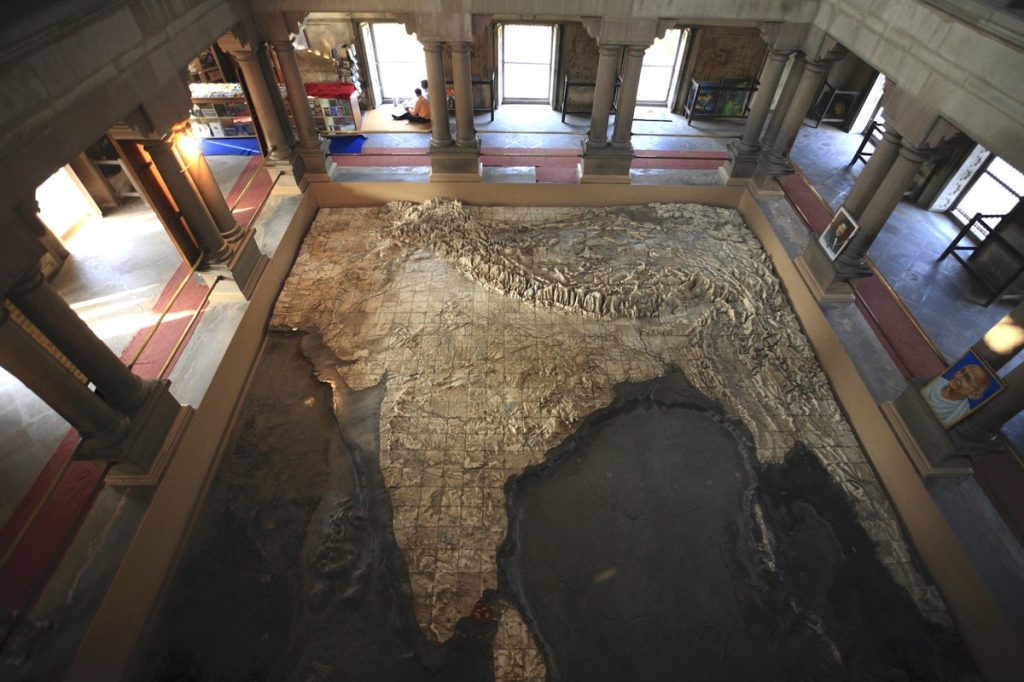
There are quite a few Bharat Mata temples and they are fairly new. However, they have deep roots in Indian history and cultural context. The earliest reference of the word Bharati comes in Apri-Suktas of Rigveda where she is mentioned as Vakdevi or Goddess of speech. Then there is also a contemporary idea of Bharat Mata which emerged during the Indian independence movement. We see it mentioned in the ‘Vande Mataram’ song by Bankim Chandra Chatterjee. Visually, Abanindranath Tagore, the artist nephew of Rabindranath Tagore created the first painting of Bharat Mata in 1905 CE. She is depicted wearing a saffron sari with four hands like most Hindu goddesses. In her upper hands, she holds the scriptures and a piece of white cloth. In lower hands, she has a sheave of paddy and an Akshamala. Her hands hold the essentials of human life: education, initiation, food, and clothing.
Bharat Mata temple at Varanasi is unique in many ways. It was built between 1918 and 1924 CE, and was formally inaugurated by Mahatma Gandhi in 1936 CE. The temple celebrates the idea of Bharat as it is described in ancient scriptures. And since it was created during British rule (when the independent nations had not emerged), the map here includes the territories of present-day Afghanistan, Pakistan, Bangladesh, Sri Lanka and Myanmar. A detailed map of Bharat, created using the marble from Makrana, is the heart of the temple. When you see different mountain ranges, you see them in the same proportion as they exist on earth. The map contains the natural resources of the land but nothing man-made. The land remains sacred.
Temple of the Visa God, Hyderabad
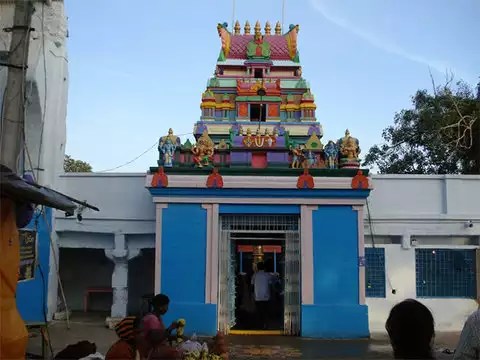
Chilkur Balaji, literally meaning the small Balaji, is one of the oldest and most famous temples in and around Hyderabad. It is a wish-fulfilling temple; whatever you wish here, it comes true; no guarantees, though. Anyway, the deity here has a special reputation of being a Visa God i.e., a God that specialises in fulfilling the wish of stamped Visa on your passport.
A curious thing you find being sold here is a card with numbers 1 to 108 marked on it along with a basic pen. What you are supposed to do is, you take 108 parikramas (rounds) around the temple once your wish is fulfilled. Since you tend to lose count, these cards help you to remember.
Temple of Holy Rats, Bikaner
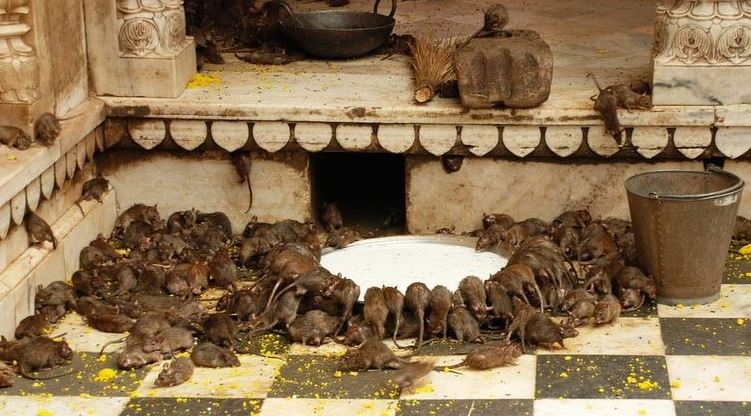
There are roughly 20,000 black rats. They roam around the temple, they jump around the idol of Karni Mata in the sanctum, as if they are oblivious of the human presence around them. You see them drinking milk or nibbling at the prasad offered to the goddess. This is the common sight at Karni Mata temple, located around 30 Kms from Bikaner. In a corridor around the temple, a man called Mana Singh Ji sings devotional songs telling the story of Karni Mata, as the rats jump around.
Karni Mata is a revered form of a real woman who lived in the 14-15th century. The legend says that her son Laxman died while trying to drink water from Kapil Lake. She would not let Yama, the god of death, take her son away. Yama finally gave in but he gave back the son as a rat. Since then, all her male progeny are supposed to live here like rats. Locals believe that when someone from their caste dies, he or she is reborn as a rat in the temple and vice-versa. This means that the total population of rats and humans remains constant in that area.
Temple of a Sikh Soldier, Nathu La Pass

If someone tells you that there is a soldier who continues to perform his duties decades after he actually died while on duty, would you believe it? Most likely, not. However, this is the story of Baba Mandir close to Nathu La pass (gateway to Indo-China route) in East Sikkim.
Baba Mandir is a temple dedicated to a soldier who served the Indian Army’s 23 Punjab Regiment. His name was Sepoy Harbhajan Singh and he came from a Sikh family in Kapurthala district of Punjab. Born in 1946, he was recruited into the Indian Army in 1966. In 1968, when he was posted at the border and was leading a mule column from his battalion headquarters, he slipped and fell into a glacier and died. The Army made an extensive search for his body for three days but could not locate him.
Then, something surprising happened. It is said that Harbhajan Singh appeared in the dreams of his colleagues and he directed them to his own body. And they found it. Some time after his death, the battalion built a Samadhi for him, and the place became a pilgrimage site for both the Army men as well as civilians. People here believe that Baba guards the border and takes care of his people. Some even suggest that he comes to his Samadhi every night, wears his uniform, and takes his rounds in the region. His uniform is duly hanged and his shoes are polished every day. And whenever there is a flag meeting between the Indian and Chinese Army, an empty chair is kept for him.
These are only some of the temples and some of their stories. There are many more, with improbable narratives and bizarre ways of worship, which continue to rise and fall with the passage of time.
 Kalampedia