
The Arabs of the seventh century, inspired by their own version of Islam, poured out of Arabia and spread east and west, overthrowing decayed kingdoms and imposing the new faith. They moved fast. In the west, they invaded Visigothic Spain in 710; in the east, in the same year, they moved beyond Persia to invade the great Hindu-Buddhist kingdom of Sindh. The Arab account of the conquest of Sindh is contained in the book called the Chachnama, written in the 13th century by a Persian scholar Ali Kufi.
According to Chachnama, the Arabs turned their attention to Sindh at some time between 634 and 644, during the reign of the second caliph or successor to the Prophet, and in the next sixty or seventy years made ten attempts at conquest. The aim of the final invasion was not just the propagation of the faith. The invasion was a commercial-imperial enterprise; it had to show a profit. Revenge was a subsidiary motive; but what was required from the conquered people was not conversion to Islam, but tribute and taxes, treasure, slaves and women.

The Chachnama begins with an account of the native dynasty of Sindh that is to be overthrown by the Arabs. In this part of the narrative dates are few, and there are elements of the fairy tale. The dynasty was founded by Chach. Chach was a brahmin ascetic who lived with his brother in a village temple. One day he went to the palace of the king and offered his services as scribe and secretary to the chamberlain. Chach was tall and handsome; he spoke well and wrote a beautiful hand. He became first a correspondence clerk; then chamberlain when the chamberlain died; then prime minister.
It happens one day that the queen, normally secluded in the private apartments of the palace, sees the handsome brahmin prime minister. She falls in love with him and makes a declaration to him. He is nervous. He tells the queen that there are four things men should never trust or take for granted – a king, fire, wind and water. But the queen pleads; she asks only to be allowed to look at Chach once a day. And in the end she has her way. Chach, the brahmin ascetic, becomes the queen’s lover, and his power in the kingdom of Sindh is second only to that of the king.
Some years pass. The king falls ill and then is near to death. The queen, who has no children, fears that she will now be displaced and degraded by the king’s relations. Through Chach she orders fifty sets of chains to be secretly brought to the palace. The king dies; the news is not given out; the physicians are detained. All the claimants to the throne are summoned in the king’s name to the palace. As they arrive they are fettered and imprisoned. Then the king’s poor relations are summoned. They have grievances; each poor relation has his particular enemy among the claimants, and now he is given the chance, as though on the king’s order, to cut off the head of his enemy and take possession of his property.

When all the claimants are killed, it is announced that the king has appointed Chach as his regent; then it is announced that the king has died. Gifts are made to powerful nobles; the queen places the crown on Chach’s head; and the people acclaim Chach. The dead king’s brother (a ruler himself in a neighbouring state) disapproves. He marches into Sindh, claims the throne for himself, and challenges Chach to single combat. Chach says, “I am a brahmin. Brahmins do not fight on horseback.” The dead king’s brother dismounts. Chach jumps on a horse and cuts off his challenger’s head. And that is that.
Chach rules for forty years. It is Chach who repulses the first Arab attack, a sea attack on the port of Debal (which might be Banbhore). On Chach’s death the kingdom passes to Chach’s brother, and then to Chach’s son, Dahar.
Dahar is told one day of a wonderful brahmin astrologer. And since it is good for a king to consult wise brahmins, Dahar gets on his elephant and visits the astrologer. For Dahar himself the astrologer predicts nothing but good fortune; but this is clouded by what the astrologer says about Dahar’s sister. The man Dahar’s sister marries, the astrologer says, will rule the kingdom. Dahar is perplexed. His prime minister (who is a Buddhist) has a solution: since a king’s first duty is to his throne, Dahar should go through a form of marriage with his sister.
Dahar is shocked by him prime minister’s advice. The prime minister goes home, takes a sheep, scatters earth and mustard-seed in its wool, waters it. After some days the mustard-seed sprouts, the sheep turns green. The sheep is then driven about the town and people rush to see it. But after three days the wonder abates; the green sheep is taken for granted. The prime minister says, “O king, whatever happens, whether good or evil, the people’s tongues wag about it for three days. Thereafter no one remembers whether it was good or evil.” Now Dahar goes through a marriage ceremony with his sister.
On the other side, after the failure of the first two expeditions against Sindh, the third caliph, Osman (644-656), orders a detailed report on the affairs of ‘Hind and Sindh’ – its rules of war, its strategy, the nature of its government, the structure of its society. The order goes to Abdullah, and Abdullah passes it on to Hakim; and Abdullah is so impressed by what Hakim has to say that he sends Hakim direct to the caliph.

“O Hakim,” the caliph says, “have you seen Hindustan and learnt all about it?”
“Yes, O commander of the faithful.”
“Give us a description of it.”
“Its water is dark and dirty. Its fruit is better and poisonous. Its land is stony and its earth is salt. A small army will soon be annihilated there, and a large one will soon die of hunger.”
“How are the people? Are they faithful, or violators of their word?”
“They are treacherous and deceitful.”
The caliph takes fright at this last piece of information, and forbids the invasion of Sindh. Then, towards the end of the seventh century, Hajjaj becomes governor of Iraq, Sindh and Hind. Hajjaj has first to deal with religious-racial disaffection in Kufa and Iraq. Then he too sends an army to Sindh: King Dahar of Sindh has been encouraging Muslim rebels.
Hajjaj’s army is defeated by King Dahar’s son. The Arab commander is killed, and Arabs are taken prisoner. The reigning caliph wants to hear no more of Sindh. The country is too far away, he writes Hajjaj; the people are too cunning, the expeditions are too expensive, and too many Muslims are being killed. But Hajjaj asks for another chance; he promises to pay back to the royal treasury double the sum spent on a new invasion. The caliph agrees; he gives a written order for the invasion of Sindh. Hajjaj selects 6,000 experienced soldiers from Syria, appoints his seventeen-year-old son-in-law Mohammed Bin Qasim general, and superintends every detail of the preparations.
Bin Qasim arrives at the port of Debal. The supplies sent by sea arrive the same day. But Hajjaj doesn’t give order to engage in battle until the eighth day. At the end of that day a brahmin comes out of the town. He tells the Arabs that the town is guarded by a talisman: the four long flags of green silk that hang down from the arms of the flagstaff on the dome of the great temple of Debal. While the flagstaff stands, the brahmin says, the people of Debal will fight.
It is the first of the betrayals that will assist the Arab conquest. But they are not betrayals, really. They are no more than the actions of people who understand only that power is power, and believe they are only changing rulers; they cannot conceive that a new way is about to come.
Bin Qasim asks his catapult engineer, Jaubat, whether he can knock down the flagstaff.
Jaubat says, “If we remove two ramrods from the big catapult, with three stones I will blow off the flag and the pole and break the dome of the temple.”
“Ten thousand dirams for you if you do that,” Bin Qasim says. “But if you fail? And if you spoil the caliph’s catapult?”
Jaubat says, “Let the hands of Jaubat be cut off.”
That is the compact (but it has to be ratified by Hajjaj). And on the next day, while the Arabs attack the town from four directions, the big catapult is placed where Jaubat says, the five hundred catapult men pull on the ropes and the stones are shot off and the flagstaff and the dome are shattered. And it is then as the brahmin said: the defenders of Debal open their gates and ask for mercy. But Hajjaj has issued precise instructions for this first victory: the residents of Debal are not to be spared. The Arab army has to slaughter for three days: it is what Bin Qasim tells the people of Debal.
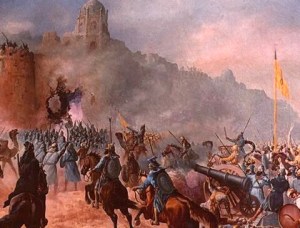
After the slaughter, the booty: the treasure and the slaves. One-fifth, the royal fifth, is set aside for the caliph, “in obedience to the religious law”; Hajjaj’s treasurer takes charge of that. The rest of the booty of Debal is distributed fairly, according to Arav practice: a cavalryman getting twice as much as a camelman or foot-soldier.
The war is far from over. Sindh is big, and has many fortified towns. But Debal sets the pattern: the siege, the betrayal by nobles or brahmins or Buddhist priests who do not believe in killing; the entry by the Arabs; the killing; the checking and distribution of the booty, after the caliph’s fifth has been deducted.
It is in district of Siwistan that the people get to understand the nature of the invader. A spy from the Chanas tribe sees the Arabs at prayer in their camp: the whole army standing up, a picture of equality, unity and union, the general leading his men in prayer, but at one with them. The effect on the Chanas people is immediate. They go in a body to the Arabs and surrender.
Eventually, King Dahar is defeated and killed. When Hajjaj gets Dahar’s head and Bin Qasim’s reports of victory, he writes sternly: My dear cousin, I have received your life-augmenting letter… But the way of granting pardon prescribed by the law is different from the one adopted by you. The Great God says in the Quran, “O true believers, when you encounter the unbelievers, strike off their heads.” My distinct orders are that all those who are fighting men should be assassinated, and their sons and daughters imprisoned, and retained as hostages.
This is precisely what follows. However, there is a final twist in the tale.
Dahar’s wife was bought as a slave Bin Qasim with part of the loot of Sindh. And Dahar’s two daughters were sent in the charge of Abyssinian slaves to the caliph. The elder of these daughters was called Surjidew. When the caliph tried to embrace her, she jumped up and said, “May the king live long! I, a humble slave, am not fit for your majesty’s bedroom, because the just Amir, Imaduddin Mohammed Bin Qasim, kept us both with him for three days and then sent us to the caliph. Perhaps your custom is such, or else this disgrace should not be permitted by kings.”
The caliph bit his hand. He immediately ordered a letter to be sent to Bin Qasim, ordering him to ‘put himself in raw leather and come back to the chief seat of the caliph’.
Bin Qasim was on the Indian border. He obeyed. He asked his men to put him in a fresh hide, to put the hide in a box, and to send the box to the caliph. He died within two days. The body, when it came to Baghdad, was displayed by the caliph to the daughters of King Dahar. “Look,” he said, “how our orders are promptly obeyed by our officers.” And then Surjidew said she had lied, to be revenged on Bin Qasim. She and her sister were both virgins; they had not been touched by Bin Qasim. The caliph immediately ordered the two sisters to be buried alive in a wall.
Reference books:


 Kalampedia