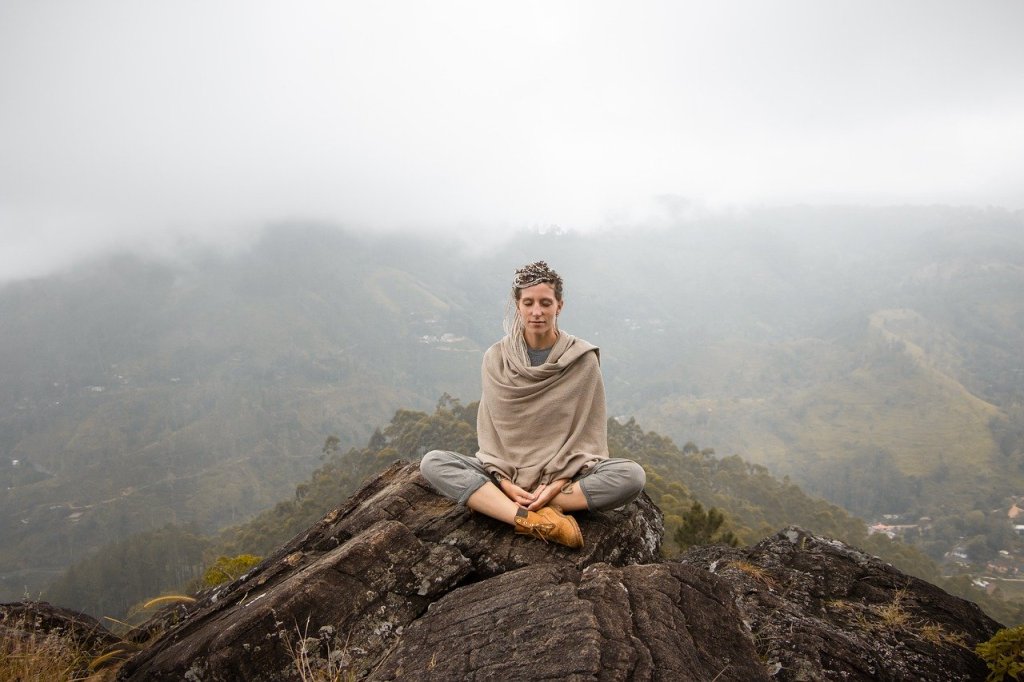
ORDINARILY we think of meditation as an activity involving our minds, but in truth meditation is initiated by assuming a specific gesture with our bodies. This gesture or posture forms the literal base on which the focused inquiry of meditation ultimately rests and depends. If we build a house with a faulty foundation, we create great difficulties for ourselves when we later take up residence. In the same way, if we do not focus our attention initially on establishing a posture that naturally supports and aids the process of meditation, we create many difficulties for ourselves as we attempt to make progress in our meditative quest.
That’s where Will Johnson’s book The Posture of Meditation offers some valuable lessons. We will briefly discuss these lessons as explained below.
On Sitting
Sit on the ground. Focus on your alignment. You should not be tilted sideways, backwards, or forwards. You should be sitting straight up as if you were supporting the sky with your head. To take this posture itself is the purpose of a meditation practice. Whatever you do after this – breathing exercises, concentration techniques etc – you will do in a much better way. In fact, when you have the right posture, you achieve the right state of mind with it, and often there is no need to attain any other special state.
Alignment
Any child who enjoys playing with building blocks understands the principles and importance of alignment. If the blocks are placed one directly on top of the other, the pile remains standing. If the blocks do not bear this vertical relationship to one another, the pile falls over.
These very same principles of alignment determine the degree of balance that is available to a human body. The building blocks of the human body are the major bodily segments: the feet, the lower legs, the upper legs, the pelvis, the abdomen and lower back, the chest and upper back, the shoulders and arms, the neck, and finally, the head. A balanced posture requires very little effort to sustain and allows the major muscles of the body to relax. This relatively small expenditure of energy, coupled with the phenomenon of relaxation, produces a distinct feeling tone of softness, ease, and vibratory flow. It also generates a natural condition of alert awareness. This dual condition of comfort in the body and relaxed alertness in the mind is the fruit of balance.
Relaxation
Relaxation is a function of the body’s ability to surrender its weight to the pull of gravity. If we are constantly bracing ourselves against the force of gravity, we cannot truly relax. That’s why alignment matters. And along with alignment you need to make sure that the muscles are not under any tension either. Within this condition of relaxation you can surrender your weight to the pull of gravity without forfeiting its uprightness.
Resilience
Stillness seems antithetical to life. In meditation practice, however, we are told to sit still. How to reconcile the two? Remember that stillness in meditation does not refer to rigidity or immobility. Instead it refers to the gradual softening and quieting of the body and mind. It is a relative term in this context. It is to be found between the two poles of an imposed immobility and constant fidgeting. The introduction of subtle resilience into the posture of meditation allows us to avoid the pitfalls of these two extremes.
The posture of meditation is a process in which the body initially aligns itself in the field of gravity, invites relaxation by surrendering its weight to the pull of that field, and then cultivates the conditions of alignment and relaxation through allowing the body to move and respond in a subtly resilient patterns of motion. When we follow these lessons in our practice, they add a lot of value to our experience.
 Kalampedia