
So far, in The Story of Kashmir series, we discussed the different aspects of the ongoing Kashmir conflict. We discussed religion, history, politics and much more. Now, we shift our focus to the most important character in this story: the people of Kashmir.
There have been many grievances on the part of Kashmiris, but the chief among them is this: Kashmiris have rarely had an opportunity to self-govern in their long history.
In 1947, when the British left India and a new Islamic nation called Pakistan was created, Kashmir decided not to join either India or Pakistan. But only a couple of months into it and the tribesmen backed by Pakistani Army invaded the princely state and captured half of it. India joined forces on the request of its Dogra ruler provided he signed the Instrument of Accession. Thus, the state of Jammu and Kashmir had its fate sealed: it became a part of India. The land captured by Pakistan remains with it.
While Kashmiris had lived more or less peacefully among themselves in its multi-religious environment (Muslims were in majority now), there have been tensions in the political sphere as the Dogra rulers belonged to minority and did not do enough for the majority. The matter was further complicated by the fact that – thanks to the British – three separate regions namely Jammu(Hindu majority), Kashmir (Sunni Muslim majority) and Ladakh (Buddhishts and Shia Muslims) were combined to form one state. These regions had their own language, religion and culture. While Jammu and Ladakh region haven’t had any major issue with the idea of becoming a part of India, Kashmiris had their suspicions.
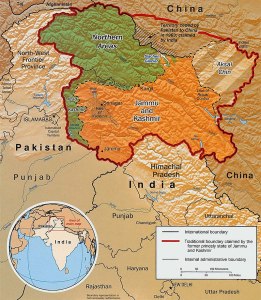
Jammu Kashmir (Ladakh included) did become a state of India and it got a special status too. Due to this special status, the state was supposed to have its own constitution and a prime minister (instead of a chief minister as was the case in other states). But India would soon realise that it was a mistake and giving such status to the state would only mean that the ties would be loosened sooner or later. Which was exactly what happened.
The tussle for power kept going on for the next few decades. India, due to its insecurities, kept interfering with the state matters. The other actor involved here, Pakistan that is, played its part by spreading radical Islam, providing weapons to the separatists and waging wars against India on the matter of Kashmir. None of these wars have had any major effect on the status quo. What was with India, has remained with India. What was with Pakistan, has remained with Pakistan. In 2019, Indian government decided to revoke the article 370 which gave special status to the state of Jammu and Kashmir.
But the frustrations of a normal Kashmiri have grown manifold. They have been tormented by the use of force by the Indian Army. Every time they have protested against the Indian rule, they have suffered immensely. On the other hand, Indian government maintains that it is only trying to curb the Islamic terrorism that has been spreading in the region. The prime example of this was the exodus of Kashmiri Hindus in 1990s when almost each one of them left its home after the attacks from extremists. So, there really are multiple layers to this issue.
- The ideal thing would have been to have a separate nation. But that seems impossible in a region where India, Pakistan and China have locked horns. Many still carry this dream but it does not look realistic, at least in today’s circumstances.
- Some Kashmiris would like to join Pakistan because of the common Islamic background.
- Some Kashmiris would like to join India but their apprehensions have grown since the rise of Hindu nationalism in politics and removal of article 370.
- The idea of a plebiscite is always on the cards but there are some major challenges. India claims that the demographics of the area under Pakistan have changed over the years and many Punjabi Pakistanis have moved in there. Pakistan also fears that in the absence of article 370, India would try to change the demographics on its own side.
- Kashmiris continue to live in one of the most dangerous, war-torn places on earth. They have got frustrated. And so they protest. But there is no clear vision, no genuine leadership. It’s only chaos. Every few days, you can hear a story on a militant gunned down by the army personnel or vice versa.
Kashmir remains an unresolved issue. Perhaps one of the most challenging geo-political case to solve alongside Israel-Palestine. But if we have learnt anything from history, it’s that the status quo changes. That nations fall and rise. That new nations are created. Only time will tell what is in store for Kashmir. But a permanent solution seems unlikely in our lifetimes.
Recommended books:
 Kalampedia