
While we looked at the Hindu and Muslim narratives in the first and second parts of The Story of Kashmir respectively, it’s also worth mentioning that the modern conflict evolved in a much more complex way. How? That’s what we will discuss in this episode.
The current crisis finds its roots in the year 1846 when — right after the first Anglo-Sikh war — the princely state of Jammu and Kashmir was established. The Dogra ruler, Raja Gulab Singh, who had helped the British in defeating the Sikhs in valley, became the ruler of the newly formed princely state while working under the British empire.
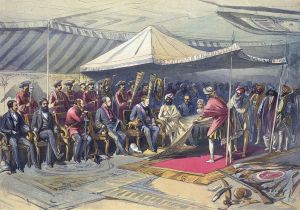
Thus began the Dogra rule in the state of Jammu and Kashmir. As stated above, the Dogra rulers were simulatenously serving the British empire while ruling the state. Due to this, the people of the valley played an important role during the independence struggle and even the world wars as they had to serve the British empire as per the agreements. Many left their homes and never came back. Today, over a million Kashmiris live in the United Kingdom. It was during this time that the people of Jammu and Kashmir started growing resentment towards the Dogra rule.
The social resentment turned into political rebellion in the twentieth century. During 1930s, the first major political party was launched: The National Conference. Its founder would soon launch a Quit Kashmir movement against the Dogra Maharaja and later become the first prime minister of Jammu and Kashmir.
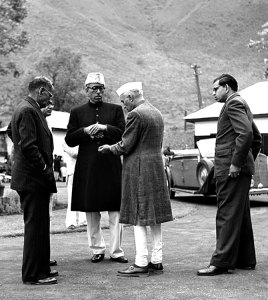
When India got its independence from the British rule in 1947, all the princely states were given three choices:
- Join India
- Join Pakistan
- Remain independent
Maharaja Hari Singh went with the last option. Not for long. Only two months after India’s independence, armed tribesmen, supported by Pakistani army, intruded into Kashmir valley and attacked the state. Shocked and scared, Hari Singh reached out to the Indian state for help and agreed to join India in return.
At the same time, India took the issue to the United Nations. This was done primarily for two reasons: first, during the tribesmen attack, Pakistan had captured a significant part of Kashmir and India wanted to take it back as it had the Instrument of Accession signed in its favour; second, it was trying to resolve the issue without getting into a war. The UN suggested a plebiscite, but India and Pakistan couldn’t agree on how to demilitarise the region. And for some reason, they still cannot.
So far, you may have noticed that it is only a struggle of powers between various rulers. But, what about an ordinary Kashmiri? What do they want? We’ll get into that in the next episode.
Recommended Books:
The Dogra Rulers of Jammu and Kashmir by Sat Prakash Suri
Kashmir and the British Raj 1847-1947 by Robert A. Huttenback
 Kalampedia