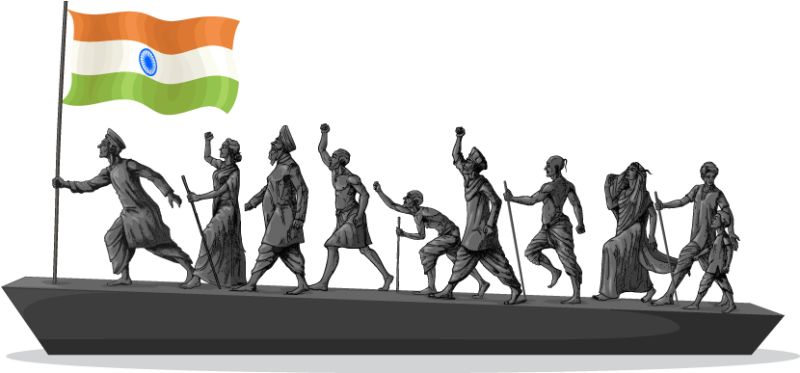
In the first and second part of the Indian independence series, we learnt about the expansion of the British Raj in India. Now, in the concluding part, we will see how the country emerged out of it as an independent nation. Let’s start then, shall wel?
While the British power gained its heights during the middle of the 19th century, the discontent of the local rulers, the peasantry, the intellectuals, common masses as also of the soldiers who became unemployed due to the disbanding of the armies of various states that were annexed by the British, became widespread. This soon broke out into a revolt which assumed the dimensions of the 1857 mutiny.
The mutiny, as we know, failed to achieve its desired outcome. More importantly, the British Crown took direct control as the East India Company was dissolved. Inevitably, the consequences of the rebellion marked the nature of political, social and economic rule that the British established in its wake. Of course, this meant more bad news for the Indians.

Introduction of zamindari system by the British, where the peasants were ruined through exorbitant charges made from them by the new class of landlords. The craftsmen were destroyed by the influx of the British manufactured goods. The Indian soldiers as well as people in administration could not rise in hierarchy as the senior jobs were reserved for the Europeans. Thus, there was all-round discontent and disgust against the British rule. At the same time, the British were trying to bring in European values to the subcontinent which, quite naturally, frustrated the people for whom religion and caste were an essential part of their lives. The long struggle had begun.
In 1885, the Indian National Congress conducted its first session in Bombay at the initiative of retired Civil Service officer Allan Octavian Hume. In 1883, Hume had outlined his idea for a body representing Indian interests in an open letter to graduates of the University of Calcutta. Its aim was to obtain a greater share in government for educated Indians, and to create a platform for civic and political dialogue between them and the British Raj.

As India entered the 20th century, the freedom struggle caught pace. Gandhi, who had returned from South Africa, became tan important part of this movement. After the First World War, he became associated with the party and remained its unofficial spiritual leader and icon for as long as he lived. The Non-cooperation Movement of 1920 and the Quit-India Movement of 1942 were quite significant: they brought whole of India together to protest against the British rule.

India got its independence in 1947. But that came at a heavy price. One the one hand, it had come after the loss of countless lives from multiple generations. On the other, even the outcome came with a feeling of bitterness as the country was divided into parts, India and Pakistan, based on the Muslims’ demand of a separate nation. The riots that started in Pakistan eventually led to the deaths of over a million people on both sides, with Hindus and Sikhs on one side and Muslims on the other. Millions of people were forced to leave their homes. The freedom hadn’t come easy.
Reference Books:
India’s struggle for Independence by Bipin Chandra, Aditya Mukherjee, Sucheta Mahajan (From 1857 mutiny to 1947, it covers all the significant events during this period)
Gandhi: The Years That Changed the World by Ramachandra Guha (Second part of the two volume biography of Gandhi, recounting his role in India’s freedom struggle)
Freedom at Midnight by Dominique Lapierre and Larry Collins (To understand the partition of India and the events around 1947-48 which involved some of the ugliest riots in the history of India)
 Kalampedia