
In the first part of the Indian independence series, we learnt about the spread of colonialism. Let’s see what followed next.
By the early 17th century, various European powers had established their trading posts in India. At one level, they were merely trying to expand their trade, and yet, on another level, they had bigger plans: push their dominance in the region. This was further encouraged by the disintegration of big empires, first Mughals and then Marathas.

British presence in India, like many other European colonial powers, has its origins in trade. Soon after the defeat of the Spanish Armada in 1588, London merchants presented a petition to Queen Elizabeth I for permission to sail to the Indian Ocean. They got their permission and the ships sailed off. But it took them many failed attempts and a number of years before they finally arrived in India.
Between 1601 and 1608, four voyages left Britain to establish trade with East Indies. Initially, the company struggled in the spice trade because of the competition from the already well-established Dutch East India Company (French had established one too). Initially, the struggle was only from business’ point of view. But it would change as the companies tried to gain dominance.
These companies adopted a policy of allying themselves with various princes and Nawabs, promising security against usurpers and rebels. The Nawabs often gave them concessions in return for the security. But, there were conflicts all the time as one would expect: whether it was about the trade permissions or the benefits reaped from it. And as it happens in politics, the competing sides would try to destabilise the enemy. Therefore, one would side with the rebels and the other with the prince or Nawab. Battle of Plassey, fought in 1757, is a perfect example in which the British East India Company defeated the Nawab of Bengal and his French allies. Over the next hundred years, they seized control of the entire Indian subcontinent and Myanmar – and briefly Afghanistan.
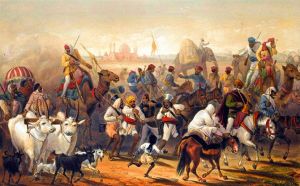
Exactly one hundred years later, a rebellion – though unsuccessful – took place which would make things worse for Indians. So far, the British East India Company functioned as a sovereign power on behalf of the British Crown. A year later, the British Crown started ruling India directly. Had the rebellion been successful, it might have uprooted the British presence from a major part of the subcontinent. But that could not happen. On the contrary, the British government got more cautious. At the same time, a significant part of the subcontinent, around two-fifths, continued to be independently governed by over 560 large and small principalities, some of whose rulers had fought the British during the ‘Great Rebellion’, but with whom the Raj now entered into treaties of mutual cooperation.
Thus, the government was established. Successive viceroys in India and secretaries of state in London were appointed on a party basis, having little or no direct experience of Indian conditions and they strove to serve two masters. Edwin Montagu was the first serving secretary of state to visit India on a fact-finding mission in 1917-1918. It’s easy to say that Indians were not happy with the arrangement. Who would be, when they are literally paying for their own oppression?
Click here to read Part Three of the Indian independence series.
PS: What happened to East India Company?
After the Crown then took over the Raj, the East India Company, shorn of its grandest possession, wound up in 1874. A few years ago, its brand name was acquired by a Gujarati Indian businessman who uses it to sell “condiments and fine foods” from a showroom in the West End of London
Reference Books:
The History of British India by James Mill (A reference book for the history on the subject until 18th century)
Raj: The Making and Unmaking of British India by Lawrence James (A complete history of the British Raj in India)
The Anarchy by William Dalrymple (Recounts the rise of the East India Company in the second half of the 18th century)
 Kalampedia