Throughout the history, women have contributed enormously to the world literature. It is no different today either. So, this Women’s Day, we present to you some of the finest Indian women authors whose writings have created a huge impact on the present generation.
Arundhati Roy

After the release of her novel The God of Small Things (which went on to win the Man Booker Prize) in 1997, Arundhati Roy became a literary sensation. To many people’s surprise, her next novel did not arrive until 2017. It’s called The Ministry of Utmost Happiness and this too got nominated for the Man Booker Prize. She has also written non-fiction and a number of essays in the last twenty years which she spent as an activist. Her prose is powerful and intriguing. Here’s a small excerpt from her latest novel The Ministry of Utmost Happiness.
She lived in the graveyard like a tree. At dawn she saw the crows off and welcomed the bats home. At dusk she did the opposite. Between shifts she conferred with the ghosts of vultures that loomed in her high branches. She felt the gentle grip of their talons like an ache in an amputated limb. She gathered they weren’t altogether unhappy at having excused themselves and exited from the story.

When she first moved in, she endured months of casual cruelty like a tree would – without flinching. She didn’t turn to see which small boy had thrown a stone at her, didn’t crane her neck to read the insults scratched into her bark. When people called her names – clown without a circus, queen without a palace – she let the hurt blow through her branches like a breeze and used the music of her rustling leaves as balm to ease the pain.
Chitra Banerjee Divakaruni
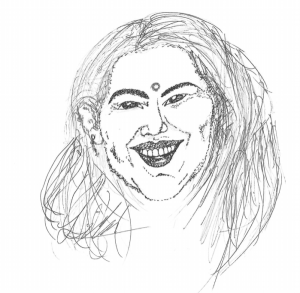
It would not be unfair to say that Chitra Banerjee Divakarni redefined the Indian mythological fiction with her book The Palace of Illusions (the story of Mahabharata from Draupadi’s point of view). The Indian-American author and poet has written a number of novels along with her poetry collection. Her fiction has been translated into 29 languages. Here’s an interesting excerpt from her book The Palace of Illusions in which Draupadi’s thought process has been explained.
For men, the softer emotions are always intertwined with power and pride. That was why Karna waited for me to plead with him though he could have stopped my suffering with a single world. That was why he turned on me when I refused to ask for his pity. That was why he incited Dussasan to an action that was against the code of honor by which he lived his life. He knew he would regret it—in his fierce smile there had already been a glint of pain.

But was a woman's heart any purer, in the end?
Kiran Desai

Kiran Desai is the daughter of reputed Indian author Anita Desai. She lived in India until the age of 15, after which she moved to England and then US. Her first novel Hullabaloo in the Guava Orchard was published in 1998. Although it gained her critical acclaim, but it was her second novel The Inheritance of Loss which won the Man Booker Prize and earned her huge reputation and fame worldwide. The below excerpt is from her book The Inheritance of Loss.
You lived intensely with others, only to have them disappear overnight, since the shadow class was condemned to movement. The men left for other jobs, towns, got deported, returned home, changed names. Sometimes someone came popping around a corner again, or on the subway then they vanished again. Addresses, phone numbers did not hold. The emptiness Biju felt returned to him over and over, until eventually he made sure not to let friendships sink deep anymore.
Anita Nair

Anita Nair’s writing journey has not been a typical one. She was the creative director of an advertising agency when she wrote her first book – a collection of short stories. Two of her novels The Better Man and Ladies Coupe have earned her wide recognition as they have been translated into more than 20 languages. Apart from six novels, she has written poetry, children stories, and other short stories as well. The following excerpt is from her book called Mistress.
Chris pauses at the top of the staircase and then walks towards the railing.

Beyond the railway lines is the riverbank. Or what is left of it. Most of the sand has been carted away to build homes. The river, when it is swollen with the monsoon rain, creeps into the houses that line the riverbank. Mostly, though, the Nila is a phantom river, existing only in the memories of those who have seen it when in full spate, swift and brown and sweeping into its waters all that dared stem its flow.

Chris stands there and takes a deep breath. I try to see the view as he is seeing it: the gleaming line of water, the many pools that dot the river bed, the herons fishing, the treetops and the tall grass that grows alongside the river, ruffled by a breeze, the distant hills and the clear blue skies, and I know fear. Already, in these few minutes of being with him, the familiar is endowed with a new edge.

I look at him. With every moment, the thought hinges itself deeper into my mind: What an attractive man.
Anjum Hasan

Anjum Hasan is a novelist, poet and a short story writer. Her first book was a collection of poems and was published by Sahitya Akademi in 2006. Next year, she published her debut novel Lunatic in My Head, which was critically appreciated. Two years after that, she wrote Neti Neti, which got nominated for Man Asian Literary Prize and The Hindu Best Fiction Award. The excerpt below is from her book The Cosmopolitans.
Sitting there on that chair for one that was big enough to hold four, Qayenaat felt disoriented and it was not just the scale of this installation, nor only the unfamiliar air of expensive perfume and boisterous laughter in proximity to art. Just fifteen minutes ago she’d been wandering in the quiet, leafy lanes of the swanky Bangalore neighbourhood of Sadashivnagar, looking for the gallery, confused about the address. At every turn she encountered soaring mansions of stupendous luxuriousness, and at every second one she’d slowed down, certain a structure so showy could not be a home, wondering if it was perhaps the place she was looking for. When she finally found it, Navya turned out to be nothing like those designer residences. It was a charming modernist throwback, a functional warehouse-like building with nothing in its simple wooden exterior to indicate that art lay within. Saraswathi Vishwanath, the woman behind it who had been converted to art not too long ago, was the Europe-returned daughter of a local, philanthropic-minded IT czar. It had taken the opening of her exclusive new gallery for Baban Reddy’s work to make an appearance in the city. Till three or four years ago, the artist was unheard of here; today, his moneyed fame ensured he was embraced as a native.
 Kalampedia